Pool Removal Cost Toronto (2026 Price Guide)
The cost to remove an inground swimming pool in Toronto and the GTA typically ranges from $5,000 to $20,000+ depending on the pool size, access, and whether a partial or full removal is performed. Several factors influence the final cost of pool removal. The five main factors include:
- Access to the backyard
- Type of pool construction
- Size of the pool
- Disposal requirements
- Partial vs full removal
Average Pool Removal Cost in Toronto
Typical price ranges in the GTA:
- Fiberglass Pool Full Removal: $5,000 – $12,000
- Vinyl Pool Partial Removal: $9,000 – $14,000
- Vinyl Pool Full Removal: $15,000 – $20,000
- Concrete Pool Partial Removal: $15,000 – $20,000
- Concrete Pool Full Removal: $20,000+
We provide pool removal services in Toronto, Markham, Vaughan, Richmond Hill, Aurora, Newmarket, Stouffville, Pickering, Ajax, Oshawa, Uxbridge and Port Perry – click here for a free quote
Please read on for a detailed breakdown of why each factor affects the price:
1. Backyard Access for Machinery
Access to the backyard is one of the most important factors when determining the cost of pool removal.
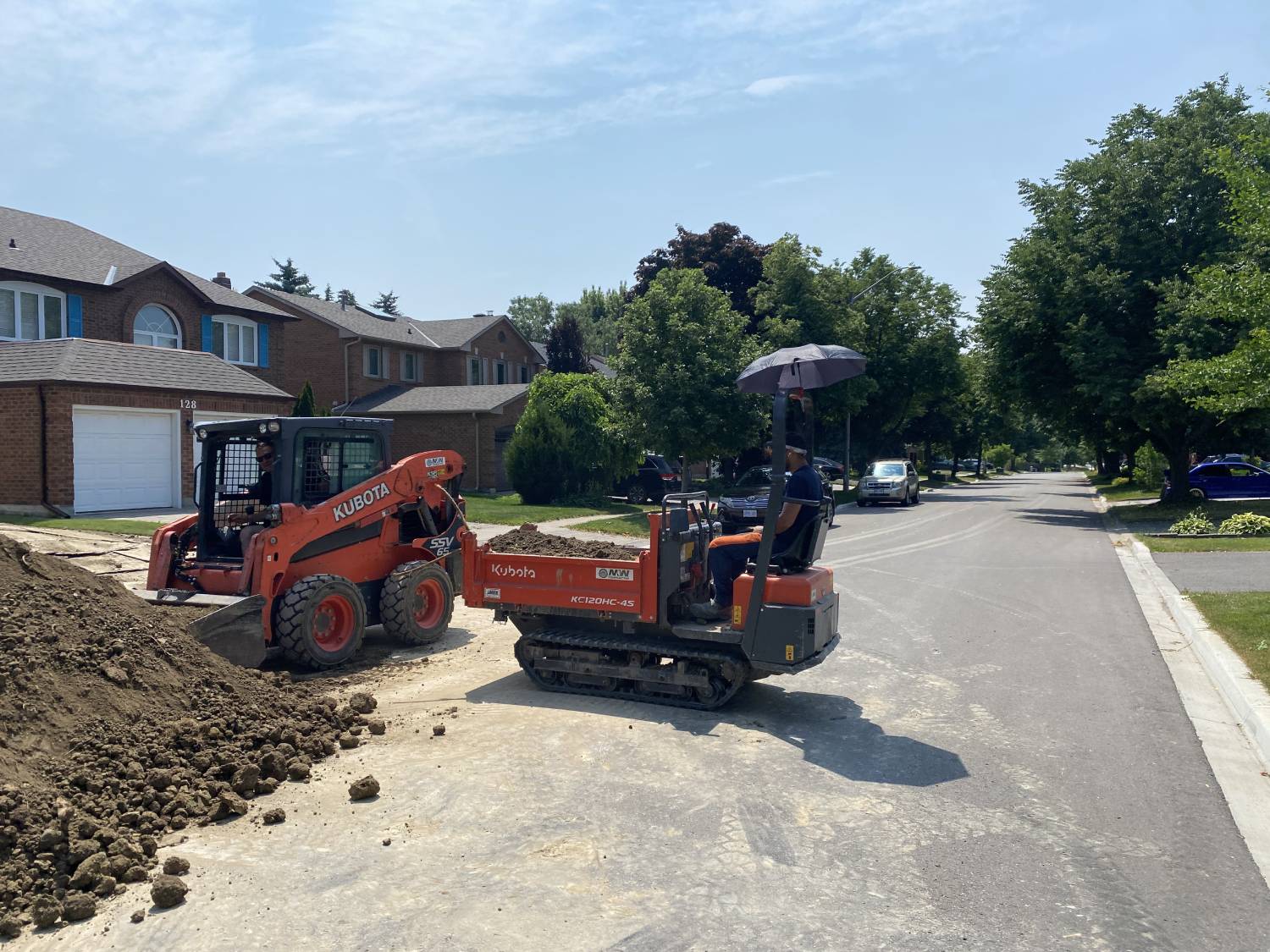
We require a minimum of 42 inches of access width to bring a mini excavator with a hydraulic jackhammer into the backyard to perform the demolition.
If your property has 61 inches or more of access, we can bring in larger equipment that is more powerful and efficient. Using larger machinery can reduce the job timeline by 1–3 days, depending on the type of pool, which can make the project more economical for the homeowner.
Access may also be restricted by stairs leading into the backyard. In these cases, temporary ramps may need to be built to allow equipment access, or the steps may need to be temporarily removed and rebuilt afterward.
2. Type of Pool Construction
There are three common types of inground pools found throughout Toronto and the GTA.
I) Concrete Pools
Concrete pools are the most solid and durable type of swimming pool. They are constructed by spraying concrete over a steel reinforcement frame, creating a thick and extremely strong shell in the ground.
Because of this heavy construction, concrete pools are the most difficult and time-consuming to remove. Specialized demolition equipment is required to break up the concrete and haul the material away.
II) Vinyl Liner Pools
Vinyl liner pools do not have a thick concrete shell. Instead, they are typically constructed using galvanized steel wall panels with a vinyl liner that holds the water.
The steel walls can be cut and removed much more easily than concrete, which generally makes these pools faster and less labor-intensive to remove.
However, most vinyl liner pools still have a concrete floor that must be broken up and removed or buried to allow for proper drainage. The concrete floor is typically thinner than the floor of a fully concrete pool and is often made from a gunite-type material.
III) Fiberglass Pools
Fiberglass pools are manufactured as a single molded shell that is installed into the ground.
Because the structure is made of fiberglass rather than reinforced concrete or steel walls, the shell can usually be cut into sections and removed more easily.
In many cases, fiberglass pools are the easiest type of pool to remove, requiring less demolition work and fewer heavy materials to break up and haul away.
3. Hauling & Disposal
The size of the pool directly affects the cost and complexity of removal.
A typical full-size inground pool is approximately 16′ × 32′ with an 8′ deep end, which is considered an average-sized pool.
Smaller pools, such as 12’–14′ × 20’–28′, may require less demolition work and material removal.
Larger pools can range from 16′ × 36′ up to 20′ × 40′, which would be considered very large inground pools and typically require more time, equipment, and disposal.
4. Disposal Costs
Additional disposal costs may arise depending on what needs to be removed to gain access to the pool.
Examples may include:
- Removing wood decks to gain equipment access
- Removing decks surrounding the pool
- Demolishing pool houses or sheds
- Removing landscaping or structures blocking access
These additional items can increase labor, disposal, and equipment costs.
5. Partial vs Full Pool Removal
When removing an inground swimming pool, homeowners typically choose between partial pool removal and full pool removal. The main difference is how much of the pool structure is demolished and removed.
Partial Pool Removal (Pool Fill-In)
Partial pool removal is the most common and cost-effective option.
Partial Removal – Vinyl Pool
For vinyl pools, the metal walls are removed and disposed of, and the concrete floor is broken up to allow for proper drainage. The broken concrete is typically buried in the deep end of the pool along with any surrounding concrete or interlocking. The pool area is then filled with clean fill material and compacted.
Typical cost range in the GTA:
$10,000 – $14,000 + HST
Partial Removal – Concrete Pool
Partial removal of a concrete pool involves:
- Breaking and removing concrete decking or interlock around the pool
- Cutting large drainage holes in both the shallow and deep ends of the pool floor
- Breaking the pool walls down at least 24 inches below grade
- Removing exposed rebar
- Filling the pool cavity with clean fill and compacting it
Typical cost range in the GTA:
$14,000 – $18,000 + HST
Partial removal is suitable for homeowners planning to use the space for grass, landscaping, patios, or general backyard use, but not for building structures.
Full Pool Removal
Full pool removal involves demolishing and removing the entire pool structure, including the walls and floor. All concrete, steel, and debris are hauled away, and the excavation area is backfilled with clean soil and compacted in layers.
Because this process requires more demolition work, trucking, and disposal, it is more labor-intensive and costly than partial removal.
Full removal is typically recommended when homeowners plan to build a structure over the area, such as:
- garages
- home additions
- permanent buildings
Typical Cost Range – Full Removal
Vinyl Pool Full Removal:
$14,000 – $18,000 + HST
Concrete Pool Full Removal:
$18,000 – $30,000+
Concrete pools require significantly more demolition and material removal, which increases both labor and disposal costs.
Engineered Pool Removal (When Building Over the Area)
If you plan to build a structure on the former pool location, an engineered fill process is typically required.
This involves hiring a soil engineer who will perform compaction tests as the pool area is filled in layers (typically every 8–12 inches). This ensures the soil meets building code requirements for structural support.
The engineer will also specify the type of fill material required, often recommending Granular B aggregate for proper compaction.
Engineered pool removals generally cost:
$30,000+
Fiberglass Pool Removal
Fiberglass pools must typically be fully removed in accordance with municipal bylaws, so partial removal is usually not an option.
However, because fiberglass is lighter and easier to cut apart, removal is often faster.
Typical cost range:
$6,000 – $12,000 depending on size and access
Which Option Is Best?
The best option depends on:
- your future plans for the backyard
- the type of pool
- property access conditions
An experienced contractor can assess your pool and recommend the most appropriate removal method.
Toronto Pool Removal, a division of MW Contracting Corp, has been removing swimming pools across Toronto and the GTA since 2008 and can help determine the best solution for your property.
Pool Removal Cost Toronto – FAQ
How much does it cost to remove a pool in Toronto?
Most inground pool removals in Toronto cost between $6,000 and $18,000, depending on the pool size, access to the backyard, and whether a partial or full removal is required.
Is it cheaper to fill in a pool or remove it completely?
A partial pool removal (pool fill-in) is usually cheaper because less demolition and disposal is required.
How long does pool removal take?
Most pool removals take 2–5 days, depending on the type of pool and access to the backyard.
Do you need a permit to remove a pool in Toronto?
Permit requirements can vary depending on the municipality and the type of removal being performed.
Ready to Remove Your Pool Completely?
We’ll walk you through the best option based on your plans and property.